
 |
|
 |
|||||||||||||||




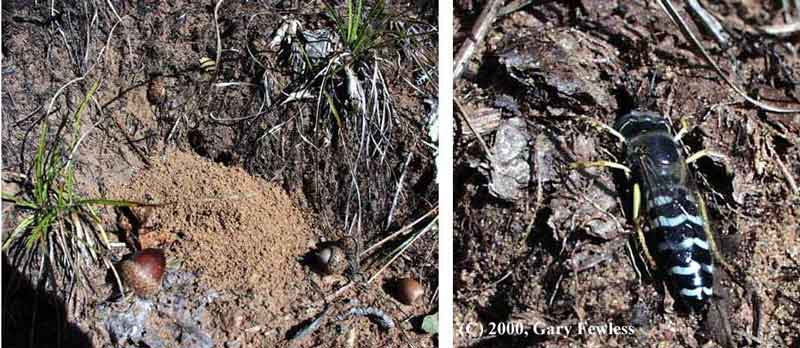
Sand wasps, as the name implies, typically occupy sandy habitats where they dig burrows in which their young can develop. They are agile hunters that often capture flies on the wing. The female wasp stings and paralyzes the fly, lays a single egg on it and leaves it in the burrow, closing the entrance with sand. A wasp larva hatches from the egg and uses the fly as a food source. Unlike other digging wasps that leave only a single cache of food for the larvae, sand wasps will continue to add fresh flies to the burrow as needed. The wasp larva eventually develops into a pupa and emerges from the burrow as an adult.
Sand wasps do not live in social colonies with a queen and workers like hornets, or yellow jackets. Each female sand wasp builds her own burrows, and only cares for her own young. However, because they like sandy habitats you often see many sand wasps living close together. This type of wasp can sting humans, but are not as aggressive and are less likely to do so than some other more infamous wasps which tend to share human habitats. The extreme close-up photo reflects their tolerance level of a large intruder in their immediate vicinity.
Thanks to Dr. Michael Draney for information on the wasp.
© 2001-2004 The Cofrin Center
for Biodiversity and the University of Wisconsin Green Bay,
All Rights Reserved
 Last
updated on
May 9, 2014
Last
updated on
May 9, 2014