
 |
|
 |
|||||||||||||||




Photo by: Steve Price
Location: Door Co., WI
Date taken: Spring 2000
Camera: Olympus CL 2500L digital camera
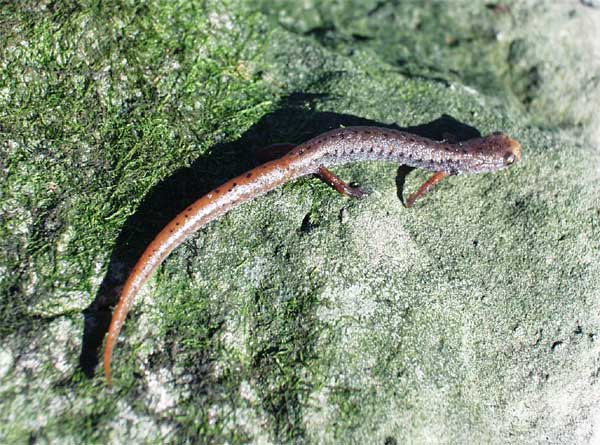
Four Toed Salamander
(Hemidactylium scutatum)
The four-toed salamander is easily identified by counting the toes on its hind feet, other salamanders have five digits. They also have a white venter with black spots, and a prominent indentation around the base of the tail. They are small salamanders, rarely reaching more than 10 cm in length. Four-toed salamanders are member of the order Plethodontidae, or lung-less salamanders. Four-toed salamanders range from Nova Scotia westward to Wisconsin, Missouri and Oklahoma, and southward to the Gulf of Mexico. Populations in Wisconsin are discontinuous and most records are based upon one or two individuals.
Four-toed salamanders inhabit sphagnum bogs, swamps, and deciduous and coniferous forests in the vicinity of fish-free ponds. Sphagnum and other mosses seem to be the preferred microhabitat for female nesting sites. Females make nest cavities next to the waters edge in the Sphagnum and will occasionally guard their eggs until hatching. Joint nesting, where many females share a nest site, also is known to occur in this species.
Four-toed salamanders are the most elusive of all Wisconsin salamanders. They can be found on the forest floor within logs and under rocks, primarily during the breeding season. This picture is of a male, who was found at Toft Point Natural Area in Door County. Note the truncated snout and enlarged premaxillary teeth; that means he is sexually active. Four-toed salamanders mate in the fall and early winter months, and deposit eggs in the early spring.Contributed by Steve Price, UW Green Bay Graduate Student
© 2001-2004 The Cofrin Center
for Biodiversity and the University of Wisconsin Green Bay,
All Rights Reserved
 Last
updated on
May 30, 2014
Last
updated on
May 30, 2014