
 |
|
 |
|||||||||||||||




Photo by: Gary Fewless
Location: Shawano Co., WI
Date taken: July 4, 2001
Camera: Olympus CL 2500L digital camera
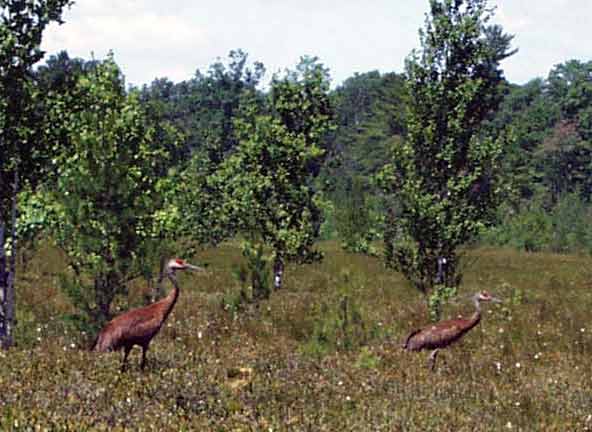
Sandhill Cranes
Click on image to see a photo of the pair of cranes (32K)
Arboretum Botanist, Gary Fewless, was surprised by a pair of Sandhill Cranes and their one chick, while collecting plants at Navarino. Sandhill Cranes are heavy bodied with long necks and legs. They have white cheeks that contrast with their grey necks and bodies. The birds are about 1.2 meters tall and have a wing span of about 2 meters. Sandhill cranes can live as long as 20 years and pairs are monogomous, mating for life. Sandhill Cranes are omnivorous and use their bills to probe vegetation in marshes and fields for seeds and other foods, including including berries, small mammals, insects, snails, reptiles, and amphibians. Sandhill cranes consume waste grain in agricultural fields and this can be a major food source.
Sandhill Cranes begin breeding at 2 to 7 years old and mate for life. The pair makes a nest several feet in diameter on the ground out of plant material. One to three eggs are laid and incubated by both the male and female. The chicks hatch in about 30 days, and cared for by both parents for about nine to ten months. Sandhill cranes have elaborate dancing behaviors that are used during courtship, and at other times. The species is partially migratory, with northern populations moving south during the winter months, while southern populations remain near the breeding sites year round. The strongest social units are pairs and families that combine (in migratory populations) into large, socially unstable flocks. These survival groups often congregate at migratory staging areas and on the wintering grounds.
When watching cranes be sure to be quiet and still and keep your distance to at least 400 yards. Even though you might not see them,some cranes will be on the lookout for you. Your close movement will cause the birds great distress, because the birds are nesting and will protect their chicks from any intruders. Remember these are big birds. Be patient - Once you get a good view, sit tight and you're likely to see some interesting behavior. Some great places to see Sandhill Cranes in northeastern Wisconsin include: Sandhill Wildlife Demonstration Area, Wood County: (tel.: 715-884-2437). Navarino Wildlife Area, Shawano County: (tel.: 715-524-2183). Crex Meadows Wildlife Area, Burnett County: (tel.: 715-463-2899). George W. Mead Wildlife Area, Marathon County: (tel.: 715-457-6771), Necedah National Wildlife Refuge, Juneau County: (tel.: 608-565-2551). White River Wildlife Area, Green Lake County: (tel.: 414-361-3149), Grand River Wildlife Area, Green Lake & Marquette Counties: (tel.: 414-361-3149), Germania Wildlife Area, Marquette County: (tel.: 414-361-3149).
Contributed by Vicki Medland
© 2001-2004 The Cofrin Center
for Biodiversity and the University of Wisconsin Green Bay,
All Rights Reserved
 Last
updated on
May 12, 2014
Last
updated on
May 12, 2014