
 |
|
 |
|||||||||||||||




Photo by: Gary Fewless
Location: Brown Co., WI
Date taken: 2000
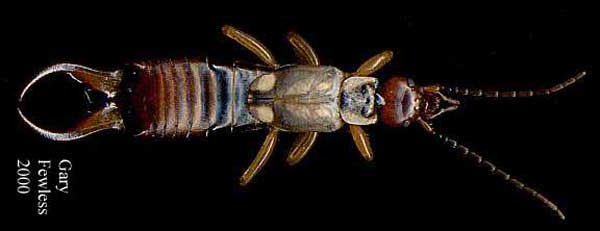
European Earwig (Forficula auricularia)
Click on image to see enlarged photo (27 K)
You might be noticing increased numbers of these formidable looking insects in your gardens or even in the house this summer. Their populations seem to be doing well in spite of, or perhaps because of the summer drought. But although they appear to be quite fierce they are fairly reclusive and very seldom reach numbers high enough to be considered a serious pest.
Earwigs are easily distinguished from other insects by the large pincer-like appendages or cerci on the end of their abdomens. There are about 22 species of earwigs in the United States, but the one that you are probably seeing in large numbers is the European Earwig (Forficula auricularia) or possibly the most common native species in this area, the ringlegged earwig, (Euborellia anulipes). The European earwigs' cerci are large and curve noticeably inward. The cerci of all earwigs are used for defense, but there is no direct evidence they are used for capturing insects for food. Males are larger than females and have larger cerci, but total lengths vary between species from � to � of an inch long.
Earwigs are good mothers and care for their young until they are large enough to forage for food on their own. Earwigs feed on flowers and organic debris, but are also important predators of insect pests like aphids. They are active at night and like to hide in dark damp areas during the day, but cannot cause damage to houses or foundations. They may appear formidable, but are rarely pests and are best left alone. Occasionally their numbers can be high enough for damage to be caused to crops or gardens. The best way to discourage infestations is to eliminate debris piles or dark damp places for the insects to hide in. If they are damaging flowers, try placing inverted flower pots stuffed with damp newspapers nearby. Collect the paper and resting earwigs during the day and move them to an area of the garden where they can feed on aphids.
Earwigs are in the taxonomic order Dermaptera, which means "skin wings". All earwigs have leathery coverings over their small wings and most do not fly. It is interesting that the association of this insect with ears has been preserved in many languages: in Old English it is an earwicga (ear-insect, or ear-wiggler), in French it is a perce-orielle (ear-piercer), in German it is an Ohrwurm (ear-worm) and in Russian it is an ukhovertka (ear- turner). There is absolutely no evidence that earwigs crawl into people's ears any more often than other species of insects.
Contributed by Vicki Medland
© 2001-2004 The Cofrin Center
for Biodiversity and the University of Wisconsin Green Bay,
All Rights Reserved
 Last
updated on
May 12, 2014
Last
updated on
May 12, 2014