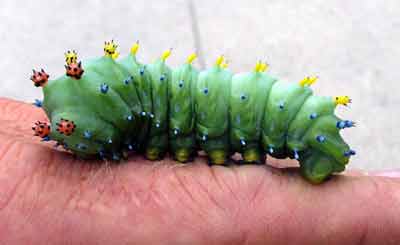
| At this time of year, you might find a large ( to more
than 4 inches) caterpillar with orange, yellow, and blue spiky bumps on
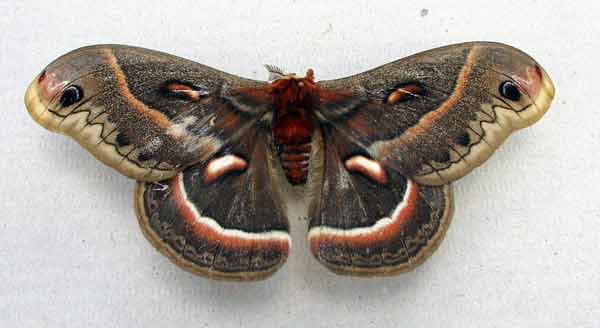
its top and sides, feeding on a backyard tree. This is the larva of the
largest species of moth in North America, the Cecropia moth (Cecropia
hyalophora). They belong to the family Saturniidae, whose members
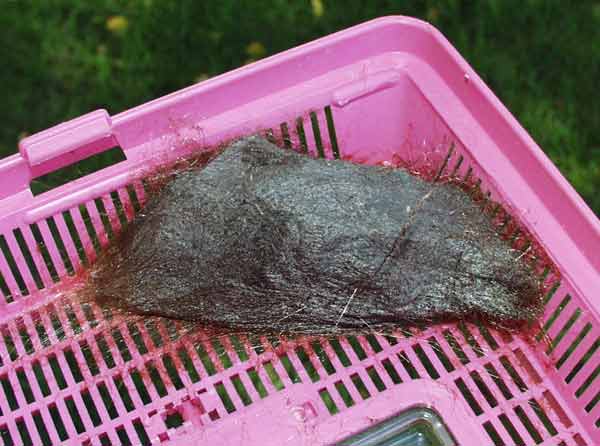
are called Giant Silkworm Moths. Their caterpillars wrap themselves in
silk secreted by their mouthparts to form the cocoon
in which they develop their adult
form. Indigenous cultures from various parts of the world harvest
silk from Saturniid species to weave into cloth. However, most silk is
from the Chinese silkworm, Bombyx
mori, which is in its "own" family, Bombycidae. The Cecropia moth is found east of the Rocky Mountains,
often in and around cities. The caterpillar eats the foliage of many trees
and shrubs, including apple, crabapple, lilac, ash, birch, alder, elm, maple,
wild cherry, and willow. The adults have non-functional mouthparts and do
not feed. There are often found near lights at night in June. There is one
generation per year. The animals survive the winter inside a silk cocoon
attached to a tree branch.
Special Thanks to Rebeka Erdman for letting us photograph
her pet caterpillar. |







 Last
updated on
May 30, 2014
Last
updated on
May 30, 2014