
 |
|
 |
|||||||||||||||




Photo by: Joel Trick
Location: Manitowoc Co.
Date taken: Sep 15, 2001
Camera: Nikon Coolpix 995
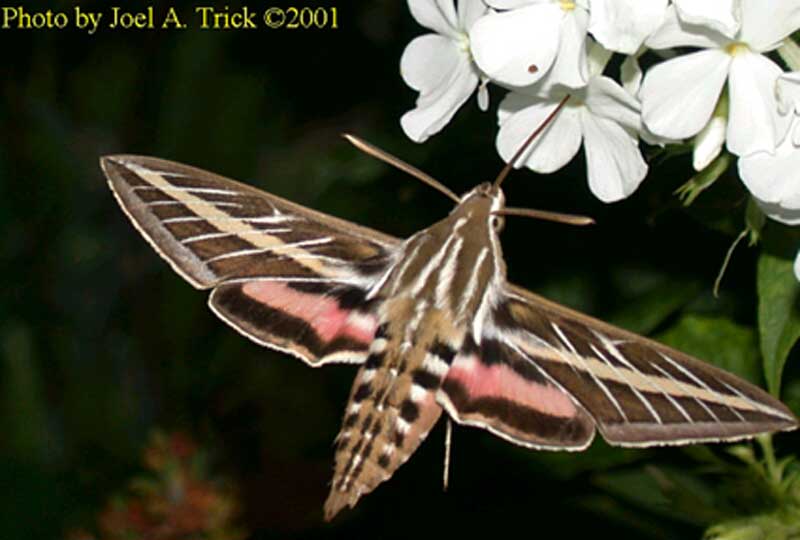
White-lined Sphinx Moth (Hyles lineata)
Click on photo to enlarge (36 K)
Sphingid moths are insect versions of hummingbirds. Both hover in midair by rapid wing beats while drinking nectar with extremely long tongues (hummingbirds) or tube-like mouthparts (moths), usually from elongated trumpet-shaped flowers that have evolved their shape to exclude generalist pollinators like honeybees in favor of more the specialized, exclusive pollination services of hummingbirds and sphingid moths. In return for a supply of nectar reserved for them, these animals do a good job of carrying pollen from flower to flower.
Some smaller species of sphingid moths fly about during the daytime just like hummingbirds, but most of the larger ones, including this white-lined sphinx, Hyles lineata (here feeding on nectar from phlox in the photographer's perennial flower beds), are usually nocturnal. The larger ones make a whirring sound with their wings that is often confused with that of hummingbirds.
The white-lined sphinx is common in our region. Its caterpillars feed on portulaca and a wide variety of horticultural plants including apple, pear, plum, grape, tomato, melon, buckwheat and turnips; as well as weedy species such as chickweed, purslane, and evening primrose. The adults fly in mid summer to early autumn, and there is more than one generation per year. The insect over winters underground as a pupa.
References
Dunn, G. A. 1996. Insects of the Great Lakes Region. University of Michigan Press.
Milne, L. and M. Milne. 1980. The Audubon Society Field Guide to North American Insects and Spiders. Alfred A. Knopf, NY.
Contributed by Michael L. Draney, UW-Green Bay
© 2001-2004 The Cofrin Center
for Biodiversity and the University of Wisconsin Green Bay,
All Rights Reserved
 Last
updated on
April 15, 2014
Last
updated on
April 15, 2014