
 |
|
 |
|||||||||||||||




Photo by: Joel Trick
Location: Manitowoc Co.
Date taken: October 1, 2001
Camera: Nikon Coolpix 995
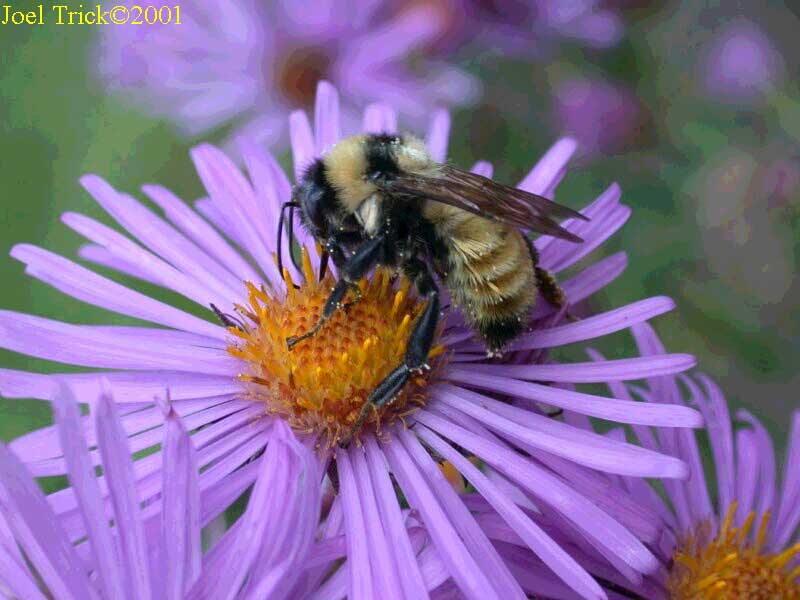
Bumble Bee (Bombus sp.) on New England Aster (Aster novae-angliae).
Click on photo to enlarge (49 K)
This photo shows a late foraging bumblebee (Bombus sp.) gathering nectar from purple aster (Aster novae-angliae). Possibly she is collecting honey to feed a developing queen back at the colony. Bumble bees are social insects and live in colonies. However, only the new queens that emerge and mate with males in the fall will survive until spring. The old queen and her retinue of workers will all die with the first heavy frosts. The young queens hibernate in sheltered areas and will emerge in the spring to start their own colony, first producing sterile worker bees, and then after mid-summer young queens and drones to continue the cycle.
It is a common misconception that yellow jackets and other wasps are more active in the late summer because they are building up food stores so the colony will survive the winter. Colonies grow slowly until mid-summer, and then population size increases quickly because there are sufficient workers to tend many young. Pest wasp species typically have 500-5,000 workers at peak population. They are more active and aggressive because they are competing with other wasps to gather enough food to feed all the developing young workers, drones (males), and especially new queens who will be the only winter survivors. Wasp colonies do not survive the winter either. Like bumble bees, only the young queens go into hibernation. The rest of the colony dies and the nest decomposes over the winter. Old nests are not re-used, instead the queen starts building her own nest from scratch in the spring.
Honeybee colonies do survive the winter. Only the drones die in the fall. Worker bees must collect enough nectar to feed and maintain the entire colony through the winter. The workers live for only about six weeks during the spring and summer, but those that emerge in the fall live through the winter. Older bees help to keep the hive warm by vibrating their wings. Honey bees can maintain warm temperatures during winter by clustering within the hive. As soon as the nest temperature drops below about 64 degrees F, the bees pack together into a carefully structured, compact ball. Workers, especially older bees actively vibrate their flight muscles to generate heat by friction. A single bee can increase heat production 25-fold. The bees will survive as long as the colony has enough food to feed the clustering bees.
Contributed by Vicki Medland
© 2001-2004 The Cofrin Center
for Biodiversity and the University of Wisconsin Green Bay,
All Rights Reserved
 Last
updated on
April 15, 2014
Last
updated on
April 15, 2014