
 |
|
 |
|||||||||||||||




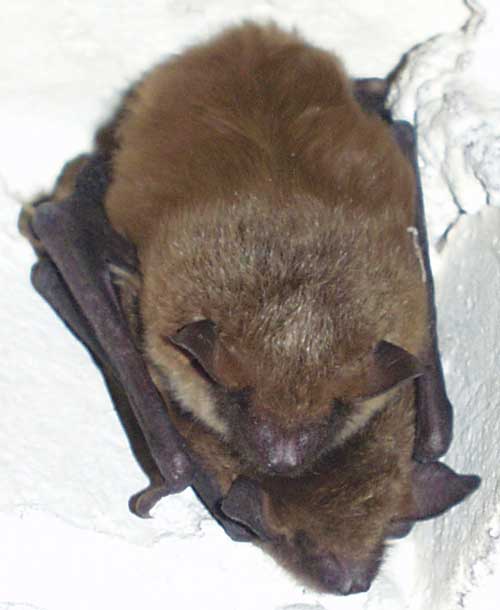
The Big Brown bat (Eptesicus fuscus), which is common throughout Wisconsin, inhabits towns, cities and rural areas dominated by farmland. During the warmer months, Big Brown bats can be found foraging after sunset. Flying low to the ground, they consume hundreds of insects, especially small beetles, every night. After foraging, Big Brown bats often use a "night roost" which is commonly a porch awning or behind a shutter. Daylight is spent in a "day roost" such as a barn, attic, or cabin.
Between December and April, Big Brown bats hibernate in caves, mines, or any favorable human structure. Eptesicus fuscus is the only bat, found in Wisconsin, hibernating in unheated attics, basements, and wall spaces. While hibernating, the heart rate ranges from 4-62 beats per minute. Fat, accumulated during summer feeding, is slowly burned off throughout the winter. Big Brown Bats are the only bats that can tolerate freezing temperatures in their hibernacula.
Many people don't like sharing their homes with hibernating bats. The only solution to remove bats is to cover up small openings leading into the house during the summer. Moving bats during hibernation generally results in the death of the bat. If you really cannot live with the bats until spring call the local wildlife sanctuary or extension office to locate someone who can safely transfer the bats to a new hibernation area.
Text contributed by UWGB graduate students Dave Marks and Steve Price
© 2001-2004 The Cofrin Center
for Biodiversity and the University of Wisconsin Green Bay,
All Rights Reserved
 Last
updated on
May 12, 2014
Last
updated on
May 12, 2014