
 |
|
 |
|||||||||||||||




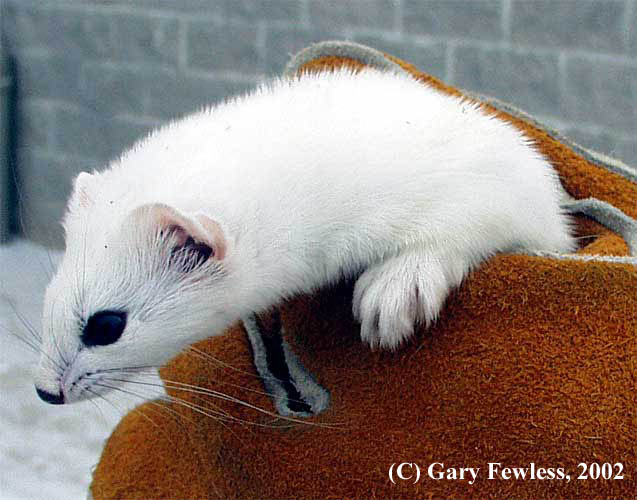
Short-tailed weasel (Mustela erminea), Family
Mustelidae.
Click on image to see a close-up.
Short-tailed weasels (Mustela erminea) are also sometimes known as "Ermine" when they are in their white winter color stage, or as "Stoat" in Europe. Their fur is brown with yellow-white underside in the summer, but turns pure white in the winter, except for the tip of the tail which is black. Farther south where the snow cover is of short duration they don't turn white in winter. They are carnivores and eat a large volume of food each day, perhaps as much as one third their body weight. Primary prey species vary depending on what is available and often include small rodents such as voles and mice, but they also eat a wide variety of other animals, some much larger than they are, including birds, squirrels and rabbits.
Adult short-tailed weasels may be as long as 15 inches, counting the outstretched tail, and weigh up to about 7 ounces. In spite of the small size they are fast and ferocious hunters. The long thin body and short legs are very distinctive and they can explore very small openings in search of prey, including the dens of ground dwelling animals, such as ground squirrels. They climb well and can swim. They sometimes kill chickens or other small farm animals, but also help control populations of wild mice, etc. which are problem species on farms.
Weasels are primarily solitary animals, except for the mating season. They are closely related to Mink, Martens, Fishers and Wolverines. Don't be misled by the friendly appearance, wild weasels don't like to be handled and can inflict very painful bites if they feel threatened.
The weasel shown above was released after his photo opportunity. Thanks to Tom Erdman and Dave Marks for weasel management services.
Contributed by Cofrin Arboretum Botanist Gary Fewless
© 2001-2004 The Cofrin Center
for Biodiversity and the University of Wisconsin Green Bay,
All Rights Reserved
 Last
updated on
May 12, 2014
Last
updated on
May 12, 2014