
 |
|
 |
|||||||||||||||




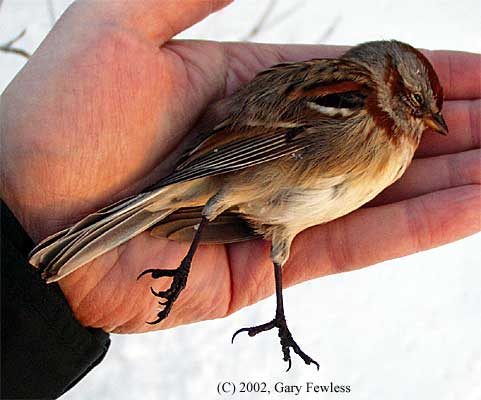
American Tree Sparrow (Spizella arborea)
We most often think of migrant birds flying north to breed in our area in the summer and returning to some warm southern location for the winter. For American Tree Sparrows (Spizella arborea) Wisconsin is one of the "southern" locations they migrate to for the winter. They spend their summers much farther north, at latitudes near and above Hudsons Bay. In fact they appear to favor the areas so far north that the continuous forests begin to give way to scattered trees and shrubs interspersed with more open grassy lands. They appear to favor the same type of partly open or "brushy" landscape when they visit here in the winter. They have usually returned to my feeders in Green Bay in early November and the last one leaves our yard in late April. Diligent birders in the area often see them a bit earlier in the fall than the date they appear at my feeders.
American Tree Sparrows tend to prefer feeding on the ground and in my experience are most active very early in the morning and again at dusk in the evening. They are very easy to recognize with a red "cap" down the center of the head and an unstreaked breast with a small black spot. They also have essentially black legs and feet and the lower yellow portion of the bill contrasts with the black upper portion. The Chipping Sparrow is similar in appearance, but lacks the black spot in the breast, has all black bill and lighter colored legs than the American Tree sparrow. These two species are both present in our area for only a very brief period each year, because the Chipping sparrows return to our area in the spring from the south at about the same time that the American Tree Sparrows leave to go north, and leave in the fall about the same time that the Tree Sparrows return. Contributed by Cofrin Arboretum Botanist Gary Fewless
© 2001-2004 The Cofrin Center
for Biodiversity and the University of Wisconsin Green Bay,
All Rights Reserved
 Last
updated on
September 9, 2014
Last
updated on
September 9, 2014