
 |
|
 |
|||||||||||||||




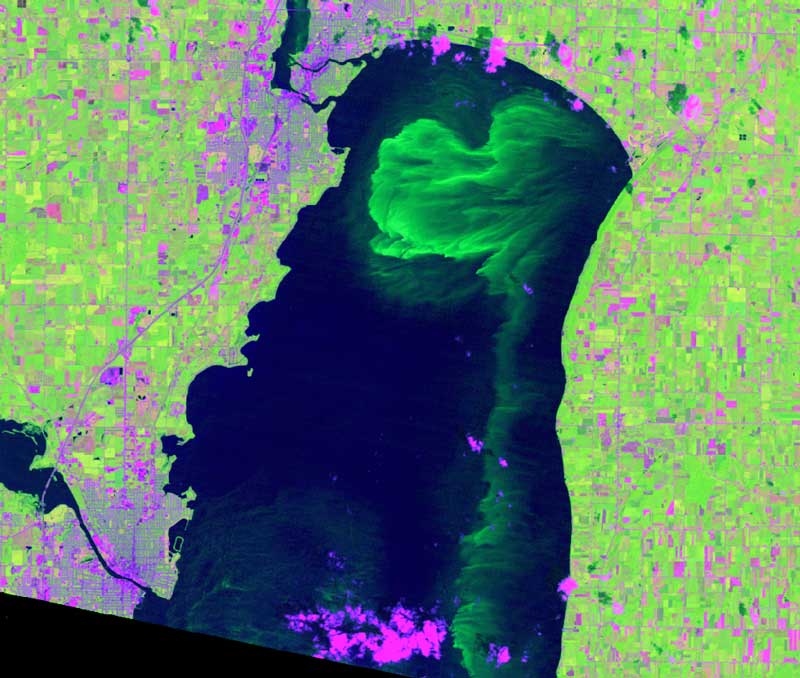
Lake Winnebago Algae Bloom
One of the most persistent ecological problems in agricultural areas is non-point source nutrient pollution. Nutrient rich runoff from fields and feedlots ends up in streams and lakes, fertilizing the growth of nuisance algae. This image shows an algal bloom on Lake Winnebago in July, 1992. Algae bloom like this in lakes when the nutrient concentrations are high (especially phosphorus since lakes tend to be phosphorus limited) and the wind speed is relatively low. Winds the day before this image was taken were blowing from the west at less than 6 miles perhour. If you had driven your boat through this bloom you probably would have seen large floating rafts of foul smelling blue-green algae.
Lake Winnebago, a shallow lake near Oshkosh Wisconsin, sits in the middle of a heavily agricultural area and so receives a substantial amount of non-point source nutrient pollution from the farms upstream. Riparian buffer strips, fertilizer control policies and manure containment units are just a few of the solutions that farmers, managers and policy makers are working on to reduce non-point source nutrient pollution.
This image was taken by the Landsat-7 satellite which takes high resolution spectrum enhanced photos of the entire planet over 16 day periods. Landsat data is collected and maintained through a cooperative effort between the USGS and NASA.
Text contributed by UW Green Bay professor Dr. Tara Reed
© 2001-2004 The Cofrin Center
for Biodiversity and the University of Wisconsin Green Bay,
All Rights Reserved
 Last
updated on
May 12, 2014
Last
updated on
May 12, 2014