
 |
|
 |
|||||||||||||||




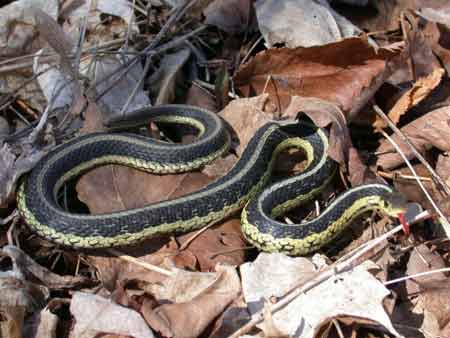
Garter Snake (Thamnophis sirtalis sirtalis)
(click on image to see close-up of the head)
As spring arrives and the weather warms
in northeastern Wisconsin, many reptiles have left their winter refuge
and become active. Among the first snakes to emerge from hibernation is
the eastern garter snake (Thamnophis sirtalis sirtalis). Eastern
garter snakes, a common inhabitant of forests, old fields, and urban parks,
can be seen in the spring time basking on rocks and hillsides in the immediate
vicinity of their hibernacula. They usually hang out by their hibernacula
for a few weeks and partake in breeding, then they disperse into the surrounding
habitat. Occasionally hundreds of garter snakes share the same hibernacula,
making spring emergence quite impressive.
All snakes, including eastern garter snakes, use their forked tongue to
sample microscopic particles from the air. These particles are put into
a special organ in the roof of the mouth called the Jacobson's organ.
The Jacobson's organ, which is highly sensitive to air-born chemicals,
is used for locating prey, finding mates, and avoiding predators.
If you look carefully, the snake pictured here has a stub instead of a
pointed tail. The stub tail could be caused of an unfortunate accident
with a lawn mower, a predator, or a car. However, often the tip of tail,
which may be in an cooler part of the winter refuge, freezes while the
snake is hibernating. The tissue on the tip of the tail dies and a stub
tail is the result.
- Text by Graduate Student Steve Price
© 2001-2004 The Cofrin Center
for Biodiversity and the University of Wisconsin Green Bay,
All Rights Reserved
 Last
updated on
April 15, 2014
Last
updated on
April 15, 2014