
 |
|
 |
|||||||||||||||




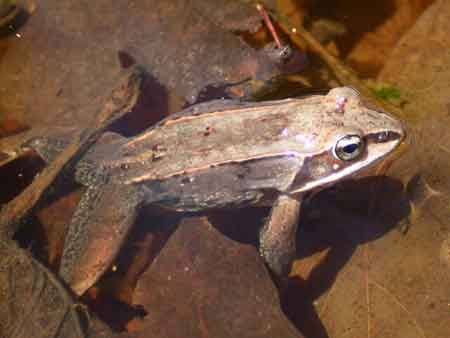
WOOD FROG (Rana sylvatica)
The wood frog is one of the first of our local frog species to begin calling each spring. After spending the winter hibernating under rocks, logs and leaf litter, they emerge shortly after the snow has melted and congregate in shallow vernal woodland pools. The sound of a breeding chorus of wood frogs is often compared to the quacking of many ducks.
Wood frogs are found mostly throughout
the state, and are most commonly associated with moist woodlands. They
are more terrestrial than most frog species, and are often seen throughout
the summer far from water, foraging on the forest floor. The range of
the wood frog extends further north than any other North American amphibian,
to above the Arctic Circle in Alaska. Wood frogs are moderate in size,
with prominent dorsolateral ridges, and are usually reddish, tan or dark
brown in color with a dark face mask. Wood Frogs have the capacity to
change color from very dark to very light, and will darken when cold in
order to absorb more heat.
© 2001-2004 The Cofrin Center
for Biodiversity and the University of Wisconsin Green Bay,
All Rights Reserved
 Last
updated on
May 12, 2014
Last
updated on
May 12, 2014