| The
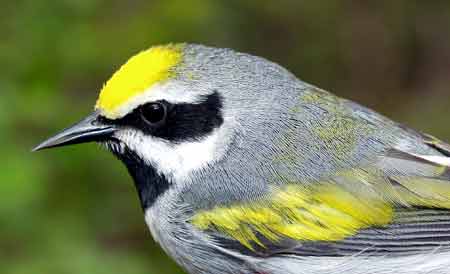
Golden-winged Warbler is one of North
America's most beautiful yet enigmatic songbirds. It also is more abundant
in Wisconsin and Minnesota than anywhere in the world, making it one of
our region's highest conservation priorities. Populations of Golden-winged
Warblers have declined 2.5% per year since 1966, for reasons that are not
completely understood. One of the likely causes involves the Blue-winged
Warbler, which hybridizes with Golden-winged Warblers to produce "Brewster's"
and "Lawrence's" Warblers. The hybrid offspring share characteristics
of both species. Brewster's hybrids have the white breasts of the Golden-winged
Warbler and the thin eye stripe and white wing bars of the Blue-winged Warbler.
The Lawrence's hybrid is produced by interbreeding of Brewster's with Blue-wings
and is much rarer and more variable in appearance, although it usually has
the face mask of the Golden-winged Warbler (a recessive trait) and the yellow
breast of the Blue-winged Warbler. During recent years, Blue-winged Warblers
have extended their range northward, leading to higher rates of hybridization
and more direct contact with the Golden-winged Warbler. Blue-winged warblers
are thought to dominate when they and Golden-winged Warblers compete for
the same food and nesting resources. Blue-winged Warblers, however, are
not as dependent on shrub habitats for breeding and might be less impacted
by shrub habitat loss. Hybrids between the two species are less successful
and have only a 50% probability of successfully raising offspring compared
to the 90% success rate of purebred pairs.
Several other factors, including urbanization and reforestation
of farmland, nest parasitism by Brown-headed Cowbirds, and deforestation
of tropical overwintering habitats, have been implicated as causes of
the decline. As Blue-winged warblers increase their range north and west
it is likely that populations of pure Golden-winged Warblers will continue
to disappear. The impact of the Blue-winged Warbler certainly is exacerbated
by the decline in favorable habitat. In order to help save the Golden-winged
Warbler from extinction, a number of studies throughout the Golden-winged
Warblers' range have been initiated to document numbers of both species
and their hybrids.
For information on Golden-winged Warbler
Atlas project see http://birds.cornell.edu/gowap/why.html
|







 Last
updated on
April 15, 2014
Last
updated on
April 15, 2014