
 |
|
 |
|||||||||||||||




Photo by: Jennifer Dzimelia
Location, Chesapeake Bay, MD
Date taken:9 July 2002
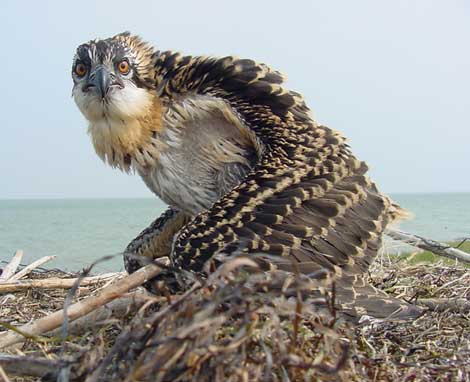
This photo of an Osprey (Pandion haliaetus) chick was taken by UW Green Bay graduate Jenny Dzimiela who is now an intern at the Blackwater National Wildlife Refuge in Maryland. North American Ospreys are migratory raptors that overwinter in the Caribbean, South America, and Central America. Every spring thousands of Ospreys return to northern lakes, rivers and estuaries. An estimated 50% of the North American population is located along the Atlantic Coast or the Gulf of Mexico. According to the US Fish and Wildlife Service, 2,000 nesting pairs inhabit the Chesapeake Bay, making it the largest known concentration in the world.
This particular nestling and its nestmate were banded on Glen Martin National Wildlife Refuge-a remote Chesapeake island refuge located approximately 15 miles off shore.
Life History:
--An Osprey ranges from 21-24 inches in body length with
a wingspan between 4.5-5.5 feet. Like most female birds of prey, the female
osprey tends to be larger than the male. It has a predominantly brown
back and white plumage covering its breast and upper legs.
Long narrow wings, dark carpal patches and a characteristic M-shaped crook
help to identify an osprey in flight, along with a dark prominent eye-stripe
and dark banding on the tail.
--Preferred habitats include shallow water estuaries, lakes and rivers. The Osprey is the only diurnal bird of prey that feeds exclusively on live fish. It hunts by soaring over water and scanning for surface schooling or spawning fish, then folds its wings tightly and plunges feet first into the water.
--Ospreys generally mate for life. Nests are built on
natural or artificial structures: snags, channel markers, duck blinds,
radio towers or flat-topped wooden platforms. Clutch size is three or
four mottled cinnamon brown eggs about the size of jumbo chicken eggs.
Incubation lasts about 5 weeks, and the 2 oz altricial chicks fledge in
8-10 weeks.
© 2001-2004 The Cofrin Center
for Biodiversity and the University of Wisconsin Green Bay,
All Rights Reserved
 Last
updated on
April 15, 2014
Last
updated on
April 15, 2014