
 |
|
 |
|||||||||||||||




Click on the images in the collage at right to see enlargements.
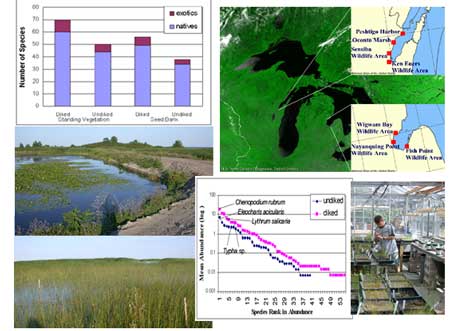
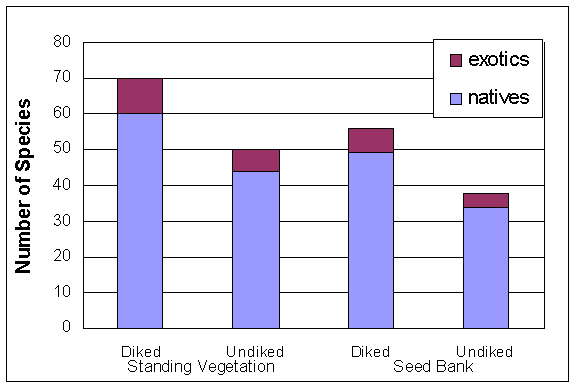
At left from top to bottom are shown a graph
of the vegetation type in diked and undiked Great Lakes coastal wetland
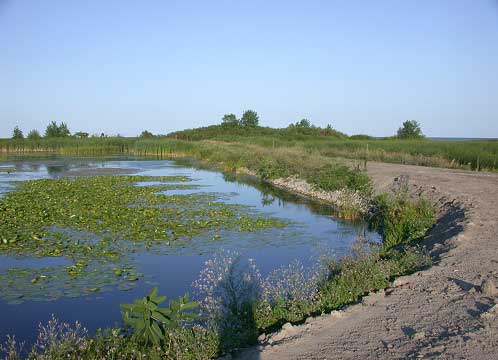
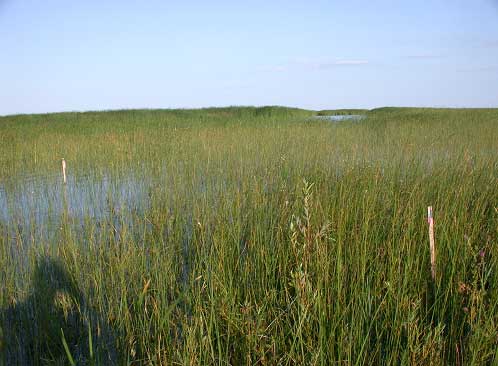
vegetation and seed banks. The photos illustrate a diked (middle) and
undiked (bottom) Great Lakes coastal wetland. At the right of the of the
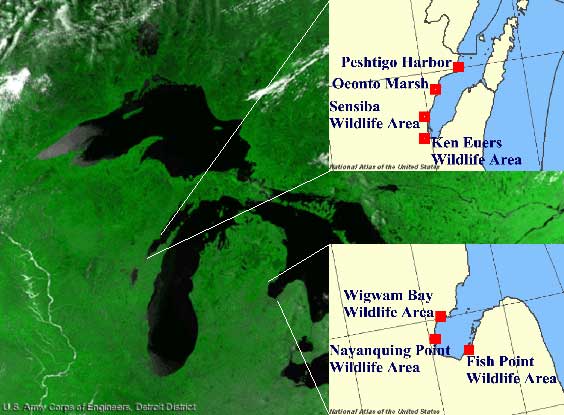
collage from top to bottom are a map of thelocations (red squares) of
the seven diked and seven undiked pairs of coastal wetlands on Green Bay
(Lake Michigan) and Saginaw Bay (Lake Huron), USA (courtesy of the United
States Army Corps of Engineers and the National Atlas of the United States).
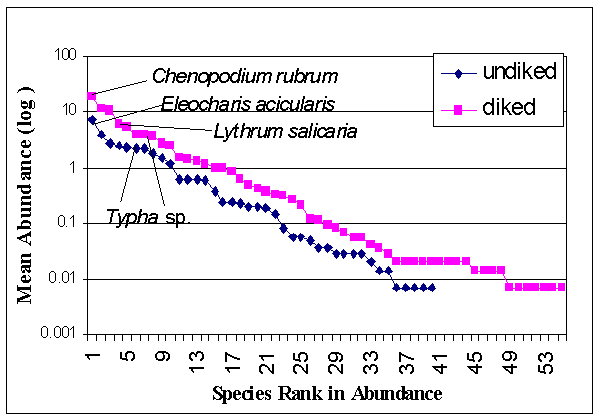
At bottom is shown the graph of the seed banks dominance diversity curves
for the seven diked and seven undiked wetlands. Dominant and invasive
species labeled. Brad Herrick is shown at the far right Identifying seedlings
in the greenhouse.
UW Green Bay graduate students Julie Gibson, Brad Herrick, David Marks, and Steve Price presented the results of their masters thesis research at the Society for Conservation Biology Meeting being held in Duluth, MN this week. Each week in July we will feature the research of these students who have worked for and done research at the Cofrin Center for Biodiversity. Their research has been supported by a donations by the Cofrin family and helps us preserve the biodiversity of birds, wetlands, and amphibians in the Northern Great Lakes region.
This week we feature the research of Brad Herrick who received his undergraduate degree at Luther College and and is now completing a masters degree in Environmental Science and Policy with an emphasis in Ecosystem Studies. He is also currently working on a research project on macrophytes and zebra mussels in Green Bay with Dr. Tara Reed.
Herrick's research compared the aquatic vegetation and
seed banks of diked
and undiked coastal
wetlands. Significant number of Great Lakes
coastal wetlands have been diked to provide protection from flooding
and to manipulate water levels for vegetation management. Dikes change
the hydrological regime by isolating the coastal wetland from natural
lake processes. He evaluated the seed banks of seven
pairs of diked and undiked coastal wetlands in Green Bay (Lake Michigan)
and Saginaw Bay (Lake Huron) in order to assess the effects of dikes on
long term vegetation dynamics. He also estimated cover of dominant
plant species in the extant vegetation. The seed banks of diked wetlands
contained more species and more seeds than those of undiked wetlands.
Diked wetlands had a mean of 21 species in the extant vegetation compared
to 16 in the undiked wetlands. Diked wetlands
contained 10 invasive species (6% of total cover); undiked wetlands contained
6 (4.1% of total cover). Some guilds of species have significantly
fewer (e.g., sandy shoreline) or more (emergent aquatics) species in the
vegetation of diked wetlands than undiked wetlands.
Seed banks in diked wetlands yielded a significantly greater density of
invasive species compared with undiked
wetlands. Lythrum
salicaria
(purple loosestrife) was the most common invasive species, found
in six of seven diked wetland seed banks. Two other common invasive
species, Phragmites australis
(giant reed grass) and Phalaris
arundinacea (reed canary grass),
were abundant in the extant vegetation but were not present in either
the diked or undiked wetland seed banks.
There are several explanations for the observed differences
between the flora of diked
and undiked Great
Lakes coastal wetlands First, the undiked wetlands were inundated with
significantly higher water levels than the diked wetlands. When the standing
vegetation was sampled in mid-August 2002, the majority of the sampling
transects were flooded under an average of 24 cm of water due to seasonal
fluctuations. However, the diked wetlands do not experience these same
water level fluctuations. Numerous studies have shown that increased water
level hinders the germination and growth of emergent wetland vegetation
(e.g., van der Valk and Davis 1978, Farney and Bookhout 1982). A second
possible explanation for the observed differences may be that because
of the diminished hydrological inputs and outputs into diked wetlands,
the vegetation cannot use wave action as vectors for seed dispersal. This
might explain the drastic differences in seed density between diked and
undiked wetlands. Third, the diked wetlands also varied greatly in size
and habitat types. Overall, diked wetlands were comprised of a much more
heterogeneous landscape than the undiked wetlands. Several diked wetlands
consisted of several different habitat types including wet forest, shrub-carr,
sedge meadow, strictly upland areas, and open water areas. Personal observation
suggests that the elevation gradient may also vary greatly between diked
wetlands. In contrast, the elevation gradient in undiked wetlands showed
a slight increase from the shoreline inward, which was relatively consistent
across all undiked wetlands. Finally, a fourth possible explanation for
the observed differences is that the diked wetlands appear to be acting
as nutrient traps. Because dikes inhibit the outward flow of water, nutrients
are trapped in the soils of these wetlands. This may increase plant productivity
as well as the number of invasive species.
Funding was provided by the Cofrin Center for Biodiversity through an endowment and contributions by the Cofrin family.
References
Farney, R.A. and Bookhout, T.A. 1982. Vegetation changes in a Lake Erie marsh (Winous Point, Ottawa County, Ohio) during high water years. Ohio Journal of Science 82: 103-107.
Hill, N.M., Keddy, P.A. and Wisheu, I.C. 1998. A hydrological model for predicting the effects of dams on the shoreline vegetation of lakes and reservoirs. Environmental Management. 22(5): 723-736.
Kling, G.W. 2003. Confronting Climate Change in the Great Lakes Region. http://www.ucsusa.org/greatlakes.
Mitsch, W.J. and Gosselink, J.G. 2000. Wetlands. John Wiley & Sons, Inc., New York, NY.
San Francisco Estuary Institute. 1998. San Francisco Estuary Baylands Ecosystem Goals Draft Report.
Van der Valk, A.G. and Davis, C.B. 1978. The role of seed banks in the vegetation dynamics of prairie glacial marshes. Ecology 59: 322-335.
Warren, S.R., Fell, P.E., Rozsa, R., Brawly, A.H., Orsted, A.C., Olson, E.T., Swamy, V., and Niering, W.A. 2002. Restoration Ecology. 10(3): 497-513.
Wilcox, D.A. and Maynard, L. 1996. State of the Lakes Ecosystem Conference: Coastal Wetlands. http://www.epa.gov/solec/96/coastal/index.htm.
Wilcox, D.A. and Meeker, J.E. 1991. Disturbance
effects on aquatic vegetation in regulated and unregulated lakes in northern
Minnesota. Can. J. Bot. 69: 1542-1551.
© 2001-2004 The Cofrin Center
for Biodiversity and the University of Wisconsin Green Bay,
All Rights Reserved
 Last
updated on
April 15, 2014
Last
updated on
April 15, 2014