
 |
|
 |
|||||||||||||||




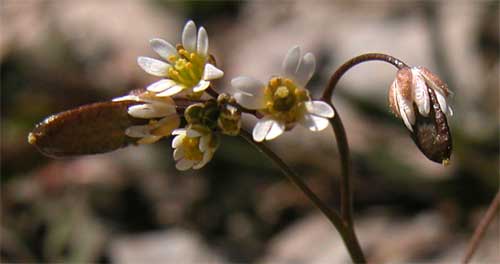
Whitlow Grass (Draba verna) Flowers and fruit
Draba verna, sometimes called Whitlow-grass, is a member of the Brassicaceae family. While not uncommon, It is often overlooked because of its diminutive size and early flowering time. Draba is an annual introduced from Europe now naturalized throughout most of North America. In Wisconsin, it flowers in early to mid-April, sometimes setting fruit by the second week in April. Look for it on sunny unproductive sites, including disturbed roadsides, lawns, and fields, where it has little competition from other plants.
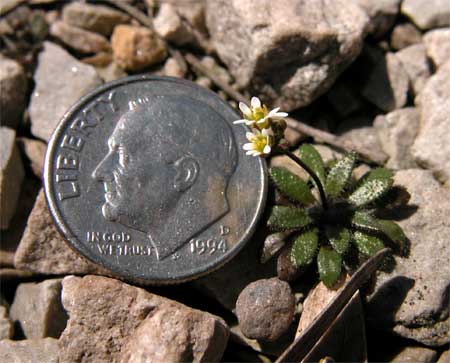
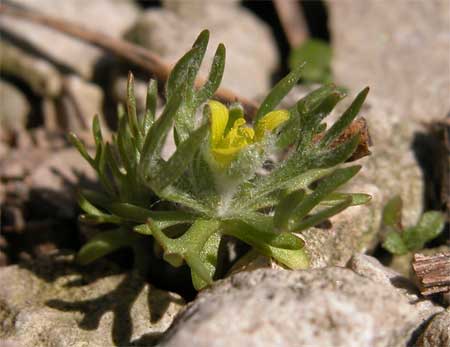
Ranunculus testiculatus, or bur buttercup, is a member of the Ranunculaceae family. It is from Eurasia and is quite common in western and central plain states of the U.S where it is rapidly spreading in arid and semiarid conditions. Occasionally it is also found in Wisconsin where it flowers in April. The epithet, testiculatus, comes from the appearance of the individual achene (seed).
Contributed by UWGB graduate student Kathy Groves
© 2001-2004 The Cofrin Center
for Biodiversity and the University of Wisconsin Green Bay,
All Rights Reserved
 Last
updated on
April 15, 2014
Last
updated on
April 15, 2014