
 |
|
 |
|||||||||||||||




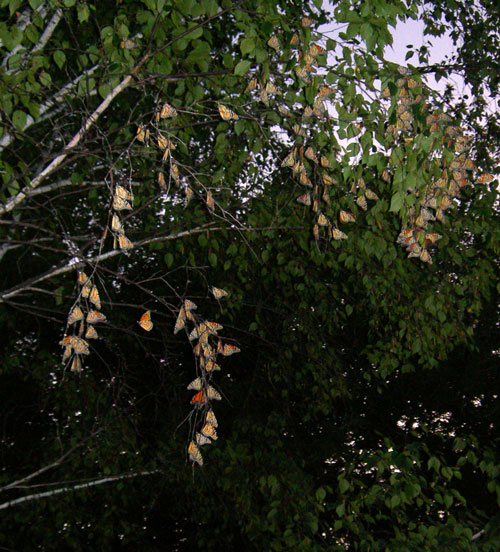
Monarch Butterflies (Danaus plexippus) roost during migration in Seymour, WI
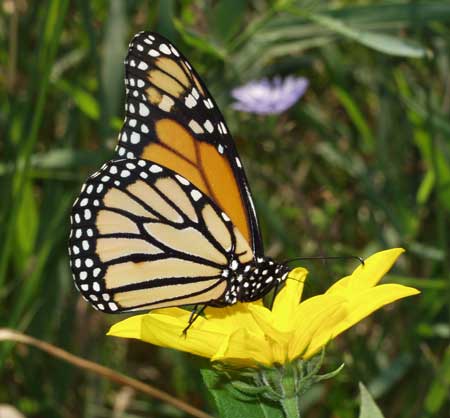 These monarch butterflies were found roosting in this birch tree on August 30, 2008. They or others roosted in the same trees for the next several days. Monarchs only fly during the day and gather in trees to rest after a long days flight south in their annual migration. Each year monarchs travel from Canada to Mexico and back again, traveling as far as 4000 km (mi) during their 4 month migration. They reach central Mexico in November and roost by the tens of thousands in trees without feeding until May. But why the stopover in Seymour? We know that monarchs need to feed heavily during the migration in order to build up fat reserves to sustain themselves while they overwinter in Mexico. The owners of this property have converted old farmland to prairie. The abundance of goldenrod and asters, are a favored nectar, may have attracted the monarchs.
Monarchs are one of the few truly migratory insects and are certainly the only ones with such a complex migration. Adults born in the late summer feed and build up fat reserves in order to fly south to California or central Mexico to overwinter. Monarchs from the north eastern Great Lakes region always fly to Mexico. Good places to view migrating monarch are along the lake shores of the Great Lakes. After overwintering in fir forests in Central Mexico, they will head back north, stopping as soon as they find milkweed to lay their eggs on. Their offspring are the ones that complete the journey back to the far north. Those that fly south may be 3-5 generations removed from the previous year's migration.
Monarchs suffer threats in both countries. In the United States development and herbicides destroy monarch habitat.Milkweed in farm fields is an important habitat for monarch because most native milkweed habitat is gone. Transgenic “Roundup Ready” soybeans and corn encourage heavier use of herbicides that kill milkweed and have reduced Monarch habitat by at least 100 million acres since 1996, according to entomologist Chip Taylo. In Mexico illegal logging within the reserve threatens the colonies. In 1986, in response to international concern about the monarchs, Mexico set aside 56,000 hectares of land as the Monarch Butterfly Biosphere Reserve (217 sq mi), but illegal logging continues as lumber prices rise and nearly half the area is now deforested. Without the insulating wind protection of surrounding trees the overwintering butterflies desiccate or freeze.The loss of one acre of Monarch overwintering grounds may mean the loss of up to 4 million butterflies. While it is unlikely that Monarchs as a species will go extinct in the near future, the migration is under threat. Some entomologists predict the Monarch migration may be over by 2030. Canada, the United States, and Mexico are working together to preserve this unique ecological phenomenon through the North American Conservation Plan.
What can I do to help preserve the monarch migration?
Monarch Migration Organizations:
© 2001-2004 The Cofrin Center
for Biodiversity and the University of Wisconsin Green Bay,
All Rights Reserved
 Last
updated on
April 15, 2014
Last
updated on
April 15, 2014