


2019 Cofrin Student Symposium
26 March 2019, Reception starts at 1:30. Symposium from 2:00 - 4:30 pm
Phoenix Room A, UWGB Student Union
Schedule
Abstracts
Past Symposia
Please join us celebrating the accomplishments of our student researchers at the 30th Cofrin Student Symposium. Students who received Cofrin Grants to complete independent research in association with one or more Biodiversity Center managed UWGB natural areas will be presenting their results. This is an excellent opportunity to learn more about the program and student research at UW--Green Bay, especially if you are thinking of applying for a grant this year.
Tentative Schedule
| Time | Speaker | Title |
| 1:30 | Opening Reception | Meet with speakers, Refreshments will be served |
| 2:00 | Bob Howe | Introduction and History of the Cofrin Grant program |
| 2:10 | Rebecca Malcore | Identification of Coralroot Mycorrhizal Symbionts at Toft Point |
| 2:30 | Makayla Swain | |
| 2:50 | Jared Pahl | Biodiversity Video Project: Increasing awareness of collections and natural areas |
| 3:10 | Brandon Byrne and Noah Nei | |
| 3:30 | Jacob Woulf | |
| 3:50 | Matt Kugel (presented by Jon Schube) | Assessing the Distribution and Ecology of Eastern Leatherwood (Dirca palustris L. Thymelaeaceae) at the Wabikon Forest Dynamics Plot |
| 4:10 | Bob Howe | Closing Remarks |
Abstracts
Brandon Byrne and Noah Nei (major: Biology, advisor: Amy Wolf)
Spatial Distribution and Ecological Importance of Muskrats (Ondatra zibethicus) at the Point au Sable Nature Reserve in Northeastern Wisconsin.
This study focuses on use of structures by muskrats and the ecological importance of these structures in coastal wetland ecosystems. Measuring height of muskrat structures above water level determines whether or not a structure is generally active. A count of active houses provides a general population estimate of the muskrats, with mapping of these structures displaying "hotspots" of activity. The anticipated outcome of this study is a baseline estimate of the muskrat population at the Point au Sable Nature Reserve that allows for future documentation of fluctuations in muskrat numbers.
Matt Kugel (major: Environmental Science, advisor: Amy Wolf)
Ecological Factors Underlying the Distribution of Eastern Leatherwood (Dirca palustris L. Thymelaeaceae), an Important Understory Component of the Wabikon Forest Dynamics Plot in Northern Wisconsin, USA
The goal of this study is explore factors associated with the distribution of Dirca palustris in a georeferenced, intensively studied forest plot in northern Wisconsin, USA. The 25 ha Wabikon Forest Dynamics Plot was established in 2008 and has been a subject of more than 20 scientific publications ranging from spatial pattern analyses (e.g., Wang et al. 2015) to a physiological analysis of biochemical transcriptomes in water-stressed trees (Zambrano et al. 2017). All trees and shrubs 1 cm in diameter or larger have been measured and mapped precisely within a 20 m x 20 m grid established by an engineering contractor in 2008. Complete censuses of all qualifying stems (e.g., ≥ 1 cm) were conducted I 2008-09 and 2013. A third census is scheduled for summer 2018 during the period of my proposed investigation. Separate survey of soils, topography, birds, mammals, and understory plants also have been conducted on the Wabikon Plot. Because they do not produce stems 1 cm or larger, Dirca palustris stems have not been mapped, although they are a prominent and important element of the understory vegetation within the plot (Wolf pers. comm.).
Rebecca Malcore (major: Biology/Human Biology, advisor: Lisa Grubisha)
Identification of Coralroot Mycorrhizal Symbionts at Toft Point
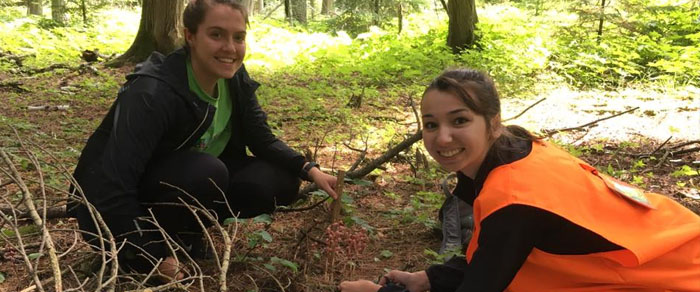
In order to germinate, orchids require the presence of specific mycorrhizae fungal symbionts in the soil, and fungal abundance may be associated with orchid dormancy periods. Corallorhiza, commonly known as coralroots, depend almost entirely on mycorrhizal symbionts to obtain nutrients, as they produce no chlorophyll. This study aims to characterize the fungal symbionts of Corrallorhiza species at Toft Point using orchid root samples and soil core samples. Using quantitative PCR, fungal abundance can be determined at different distances from a coralroot plant. Determination of mycorrhizae abundance may help to identify orchid ‘hot spots’ and allow for better monitoring of dormancy periods.
Jared Pahl (major: Design Arts, advisors: Vicki Medland and Dan Meinhardt)
Biodiversity Video Project: Increasing awareness of collections and natural areas
In order to help promote active participation in the Cofrin Center for Biodiversity's mission to preserve and protect the natural areas of the Great Lakes region, we will create a series of high quality, cinematic videos. The program will spotlight the work the biodiversity center does and highlight the beauty of the areas we study, in turn inspiring future students, scientists, and average Joes to consider doing their part to support the Center and help create a brighter future for the natural areas we all share.
Makayla Swain (major: Environmental Science, Advisor: Lisa Grubisha)
Conservation genetic analysis of coralroot orchid (Corallorhiza spp) populations at Toft Point and the Ridges Sanctuary
Coralroot orchids (Corallorhiza spp.) is a specific type of orchid that is solely dependent on a symbiotic relationship with mycorrhizal fungi, this is due to the fact that Coralroot orchids do not perform photosynthesis. There is an identified population of Coralroot orchids present in Door County, Wisconsin at both The Ridges Sanctuary and at Toft Point. Samples will be taken from the plants at these locations and DNA isolation and polymerase chain reaction (PCR) will be performed on each sample. This will allow us to identify the genetic varieties that are present in these populations. There is currently no data on genetic variation of the populations of Coralroot orchids in these areas. Collecting population genetics of the orchids present in these areas will give a better understanding on their evolutionary path. This data will be useful for future conservation in Door County, Wisconsin.
Jacob Woulf (major: Biology, Advisor: Amy Wolf)
Distribution and Ecology of Eastern Wild Turkeys (Meleagris gallopavo) within the University of Wisconsin-Green Bay Arboretum
The Cofrin Memorial Arboretum surrounding the UW-Green Bay campus has a perfect combination of the necessities turkeys need to survive. The primary goal of this project is to obtain a quantitative estimate of the Wild Turkey population and to map locations used by these birds at different times of the year. Knowing the numbers of the turkey population will help us in two ways. The first is that we will be able to gage the overall strength of the population and locations that are most critical for the population. We already predict that the turkey population is healthy and strong just by the number of sightings already recorded. The second benefit of a detailed population study is knowing where the population’s impacts are most intense so that we can determine whether a management plan is needed. If the population is impacting native species (especially understory plants and seedlings) negatively, the turkey population might need to be reduced through translocation or controlled harvest. If a turkey hunt were to be implemented, data would be collected on each bird taken to help us further understand the habits of the wild turkey. Examining a turkey can give us insight on what the bird was eating, approximate age, overall health of the bird, etc.