
 |

Observations by Gary Fewless for Green Bay WI (Lat.N 44.51° Long. W 88.02° ), except as noted. For flowers lacking conspicuous petals or sepals I define "anthesis" as release of pollen by mature anthers.
August 2003
Observations by Gary Fewless, except as noted.
| Date | Observation (Click on links for photos) |
|---|---|
| Aug 12 | Switch grass (Panicum virgatum) in flower (Anthesis), UWGB. Rough goldenrod (Solidago rigida) is also in flower on UWGB-- I saw a few plants in gardens that were flowering at least as early as Saturday, Aug 9. I also saw the first open flowers of large-leaved aster (Aster macrophyllus) in Brown County, town of Eaton. |
| Aug 11 | Big blue-stem (Andropogon gerardi) in flower (anthesis), UWGB. The flowers have been fully formed for over a week, but this is the first day they matured to release pollen. |
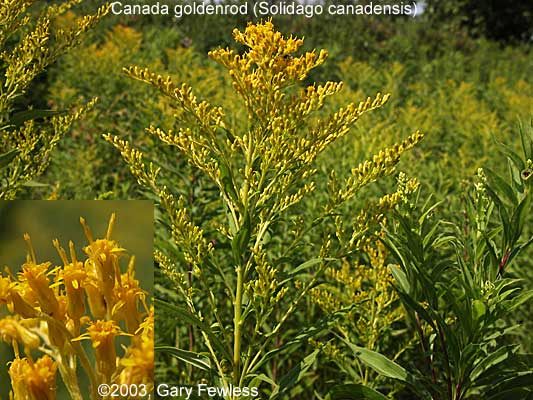
| Aug 08 | Although the earliest individuals of several goldenrod species (Solidago juncea, S. graminifolia, S. canadensis) have been noted in northeastern Wisconsin, they are still not conspicuous in most locations. We can expect a major change in the appearance of old fields and roadsides over the next few weeks as the Asters and goldenrods begin to flower in large numbers. Ragweed hayfever has begun, but is still relatively minor. |
| Aug 06 | The tall prairie grasses have begun the late season growth phase and are now very conspicuous in the UWGB prairie, although they have not yet begun to flower. Yellow coneflowers (Ratibida pinnata) and the Silphiums (compass plant, prairie dock and prairie rosinweed) are very conspicuous now. |
| Aug 05 | Streams in northeastern Wisconsin have risen with the recent rain and are at moderate levels in general, although there has been some flooding in the last week due to locally heavy rainfall. In southwestern Wisconsin, the Wisconsin River is very low with large exposed sandbars. |
| Aug 03 | Green Bay received 0.60 inches of rain. |
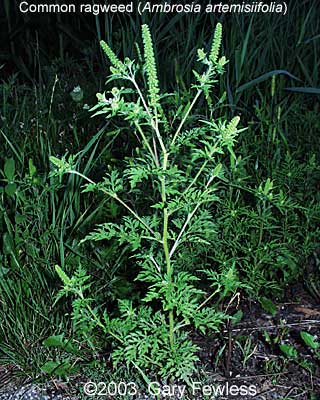
| Aug 01 | First day of flower for Canada Goldenrod (Solidago canadensis) on UWGB's Cofrin Arboretum. This is our most abundant goldenrod in NE Wisconsin, forming large clones in abandoned fields. Because it flowers at about the same time that late summer hay fever begins, it is often incorrectly believed to be the cause. The great majority of hayfever problems beginning in the next week or so and continuing into September, are caused by common ragweed (Ambrosia artemisiifolia)(Gary Fewless). |
© 2001-2004 The Cofrin Center
for Biodiversity and the University of Wisconsin Green Bay,
All Rights Reserved
 Last
updated on
May 20, 2015
Last
updated on
May 20, 2015