
 |

Observations by Gary Fewless for Green Bay WI (Lat.N 44.51° Long. W 88.02° ), except as noted. For flowers lacking conspicuous petals or sepals I define "anthesis" as release of pollen by mature anthers.
June 2005 observations for northeastern Wisconsin, by Gary Fewless, except as noted
| Date | Observation (Click on links for photos) |
|---|---|
| June 30 | This is the first day I have seen Campanula rapunculoides (creeping bellflower) in flower. |
| June 29 | Silphium laciniatum (compass plant) has begun to flower in UWGB's planted prairie. It is usually a little later than this. |
| June 28 | Tilia americana (basswood) has begun to flower, UWGB. |
| June 27 |
Lythrum salicaria (purple loosestrife) has begun to flower, west shore of Green Bay, Brown and Oconto Counties. First flower for Ceanothus americanus (New Jersey Tea), UWGB. Cercyonis pegala (Common wood nymph) butterflies have emerged on UWG campus. Green Bay's high temperature was 92 F again today and it was humid. |
| June 24 |
Both Asclepias tuberosa (butterfly weed) and Asclepias incarnata (swamp milkweed), began to flower today, UWGB's Cofrin Arboretum. The first open flowers were noted today for Cirsium arvense (Canada thistle) and Urtica dioica (stinging nettle), UWGB. Green Bays weather is hot and humid with a high temperature of 92 F and high humidity. Yesterdays high was 91. |
| June 23 |
Echinacea pallida (pale purple coneflower) in flower, UWGB. I suspect that this species had started to flower earlier on prairie plantings on sandier soils. Echinacea pallida does not grow naturally this far north, but it is commonly planted and appears to thrive in some locations after planting. A few open flowers of Cichorium intybus (Chickory) have been noted in City of Green Bay area, as early as June 18 (Kathy Groves). The earliest to flower are usually along roadsides or sidewalks. They usually begin to flower conspicuously near the end of June. |
| June 22 | Stachys palustris (hedge-nettle) in flower, Brown County (but not yet on UWGB). |
| June 21 | Trifolium fragiferum (strawberry clover) in flower, City of Green Bay. This species is a recent introduction into our area |
| June 20 | Phleum pratense (timothy) and Agropyron repens (quack grass) in flower (anthers dispersin pollen) Brown County, Town of Allouez. |
| June 19 |
Rhus hirta (staghorn sumac, previously known as Rhus typhina), Asclepias syriaca (common milkweed), Apocynum sibiricum (Indian hemp) and Leonurus cardiaca (motherwort) in flower on UWGB's Cofrin Arboretum (Kathy Groves). |
| June 18 | Catalpa speciosa (northern catalpa) and Tilia Cordata (small-leaved linden, horticultural plants) |
| June 17 | Rhus typhina (staghorn sumac) and Melilotus officinalis (yellow sweet clover) in flower, UW-Green Bay. |
| June 16 | Carduus nutans (nodding thistle) in flower, City of Green Bay. |
| June 15 |
New plants in flower, UWGB: Hypericum perforatum (St. John's-wort), Geum aleppicum (yellow avens), Heliopsis helianthoides (false sunflower). Populus deltoides (eastern cottonwood) seed dispersal is att the highest rate I have seen this year. |
| June 14 |
Convolvulus arvensis (field bindweed) in flower, Allouez. Medicago sativa (alfalfa) in flower, Brown Count, Allouez and UWGB. Melilotus officinale (yellow sweet clover), Prunus vulgaris (heal-all), Campanula rotundifolia (harebell), Anemone virginiana (tall thimbleweed) in flower, Brown County, Town of Scott. |
| June 13 | new plants in flower, UWGB: Cornus racemosa (gray dogwood), Calystegia sepium (hedge bindweed), Allium canadense (wild garlic). |
| June 12 | Several species began to flower while I was out of town between 0608 and 0612: Bromus inermis (smooth brome), Iris virginica (blue flag), Sanicula gregaria (black snakeroot), Leucanthemum vulgare (ox-eye daisy), Heracleum lanatum (cow parsnip). |
| June 08 | Hieracium aurantiacum (orange hawkweed) in flower, UWGB. |
| June 07 | Smilacina racemosa (large false Solomon's-seal) in flower, UWGB. |
| June 06 |
Tradescantia ohioensis (spiderwort) and Rosa blanda (wild rose; pasture rose) in flower, UWGB's Cofrin Arboretum prairie. Phalaris arundinacea (reed canary grass) in flower (dispersing pollen), UWGB. This is a serious invasive plant in Wisconsin and it totally dominates many wetlands, thereby excluding all native species that might otherwise grow there. |
| June 05 | I saw my first firely or lightning bug
(Lampyridae)of the year tonight. Town of Cooperstown, Manitowoc County (Joel Trick). |
| June 04 |
First "lightning bug" or "firefly" reports of the the year, Town of Ledgeview (Kathy Groves). Cornus alternifolia (alternate-leaved dogwood) in flower, UWGB. |
| June 02 |
First day of flower for Rubus occidentalis (black raspberry), Anemone canadensis (Canada anemone) and the weedy invasives Vicia cracca (cow vetch) and Sinapis arvensis (charlock; yellow mustard)), UWGB. Every year it is obvious that some species are doing particularly
well and others more poorly than usual. So far this spring it
appears that Impatiens biflora (jewelweed) is having
a banner year in moist to wet forests on UWGB and in the "sand
prairie" the same is true for Amorpha canescens (leadplant).
Earlier, it was a particularly poor showing for our two Erythronium
species (trout lilies). The weather turned cold and cloudy
just as they began to flower and it was the most meager showing
of flowers for these plants on UWGB that I have seen in over 25
years. Every year is different and the averages of events don't
do justice to the diversity that is experienced on a day to day
basis. [Late note: James Seiler of Reedsville reports that the flowers
of Erythronium that did occur seemed to stay in bloom longer
than usual.] If you are having cold like symptoms, perhaps repeatedly "clearing your throat", coughing or sneezing, you might consider the huge volume of pollen that has been released into the air over the last 3 or 4 days by Poa pratensis (Kentucky bluegrass). I think for a lot of people it is more an irritant rather than an allergic reaction, although it is clear that some people do suffer from allergies caused by this pollen. Usually it is a brief period, but there are other common grasses waiting in the wings--Bromus inermis (smooth brome) for example, and Dactylis glomerata (orchard grass) which has become much more abundant in the Green bay area in recent years. Both will begin to flower in the next few days. |
| June 01 |
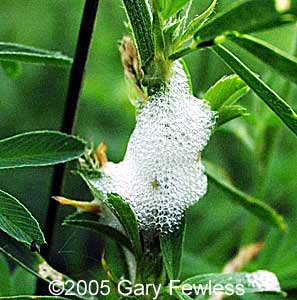
Spittlebugs first noted on plants, UWGB. The nymphs hatch about this time of year and soon produce a mass of bubbles on a host plant, presumably to protect them from predators. They are sucking insects, but their effect on plants in our area appears to be minor. I'll try to remember to get a photo of the actual insect inside the bubbles. The average date of first appearance on UWGB is May 24 and one of the most popular hosts is the alien plant species Galium mollugo, a garden escape that spreads aggressively through roadsides and inactive fields. Several plant species on UWGB's Cofrin Arboretum have begun to flower in response to a shift to warmer and sunnier days: Hesperus matronalis (dame's-rocket), Zizia aurea (golden Alexanders), Smilacina racemosa (spikenard, plants in full sun), Vitis riparia (river grape). Also in the lawns Trifolium repens (white clover) and Trifolium hybridum (alsike clover) are in flower. Pinus resinosa (red pine; Norway pine) has begun dispersing pollen on the UW-Green Bay campus. Acer saccharinum (silver maple) trees are beginning to disperse mature fruit, City of Green Bay. This is a difficult event to note precisely, because they often abort some fruits and drop them before they are mature. Androsace occidentalis (rock-jasmine) is mature and has mostly turned brown. This is a true spring ephemeral, but not of the type that is usually cited. It began to flower April 12 and was completely done by June 1. It grows on severely dry sites where there is little competition, but it must complete its growth with the spring moisture, before the warmer and drier weather begins. We usually use the term spring ephemeral to refer to forest plants that must complete most of their resource capture before the tree canopy leafs out. The big issue in that case is availability of light, rather than availability of water as in the case of Androsace. Today is the first day I noticed June Beetles (Scarabaeidae,
Phyllophaga spp.). I rescued one that blundered into UWGB's MAC
Hall, and one was attracted to my porch light that night (Mike Draney). |
© 2001-2004 The Cofrin Center
for Biodiversity and the University of Wisconsin Green Bay,
All Rights Reserved
 Last
updated on
May 20, 2015
Last
updated on
May 20, 2015