Philosophers' Café
A Meeting of
Minds
Fall theme: The Examined Life.
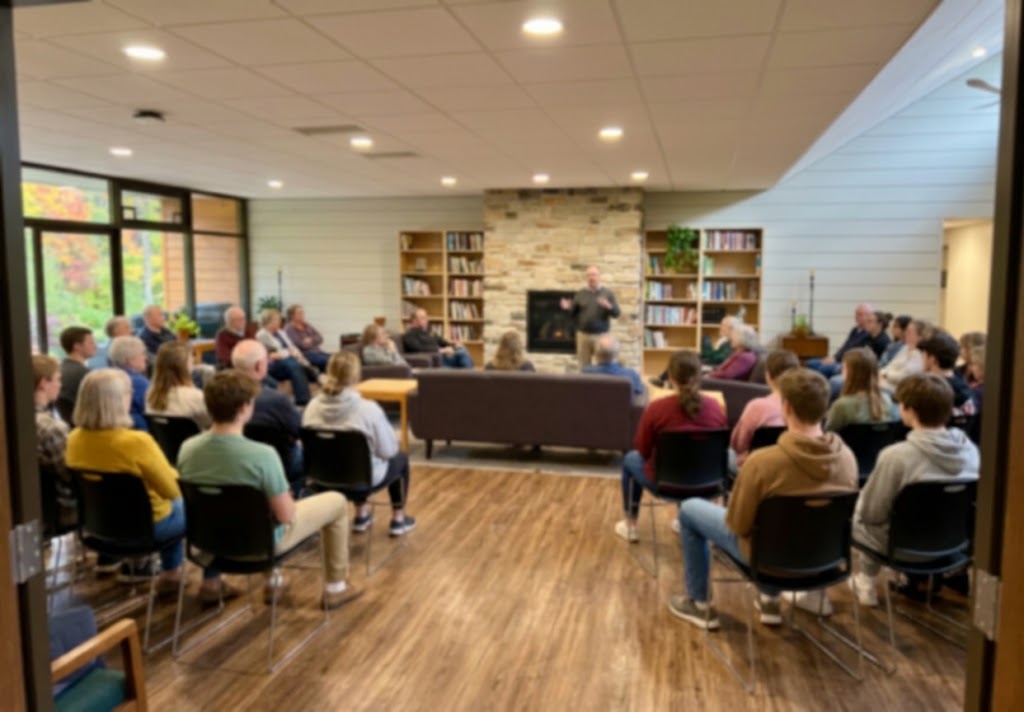
Philosophers' Café brings together UW-Green Bay students and community members for open, friendly and respectful dialogue on important issues. This fall, the series is also the anchor for a new UW-Green Bay course, Philosophers' Café — students will join the public conversation and dig deeper in seminar discussion. Join us on alternating Wednesdays at the Mauthe Center as we explore "The Examined Life" through moderated discussions led by faculty and community experts. From questions of ethics and meaning to the pressures of modern distraction, we'll dig into the ideas that shape how we live. All are welcome — no philosophy background required.
WHen?
Twice each month on Wednesdays from 5 to 6:30 p.m. But dates vary so check the schedule.
Fall 2026 Schedule
Wednesday, September 23
The Examined Life in a Distracted Age
- Led by: Robert Riordan, Lecturer in Philosophy, UW-Green Bay
- Time/Location: 5:00-6:30 p.m. at The Mauthe Center
What did Socrates mean when he said the unexamined life isn't worth living—and can we even manage it in an age built to distract us? We’ll examine one account of what it means to live an examined life, why that's so important to us, and the challenges our present age of distraction poses to it.
Wednesday, October 7
Using Anger for Good
- Led by: Ryan Martin, Dean of CAHSS and Professor of Psychology, UW-Green Bay
- Time/Location: 5:00-6:30 p.m. at The Mauthe Center
Anger gets a bad reputation, but it's one of our most important emotions. In this conversation, we'll explore what anger is really trying to tell us, why it so often gets us into trouble, and how to use it as a force for positive change. We’ll discuss practical strategies for responding to anger in ways that improve your decision making and help you use this powerful emotion for good.
Wednesday, October 21
Does an Examined Life Need Nature? Yes!
- Led by: Chris Diehm, Director of the Environmental Ethics Program, UW-Stevens Point
- Time/Location: 5:00-6:30 p.m. at The Mauthe Center
People sometimes think that to “examine life” means turning inward in self-reflection or contemplation. This talk argues it is equally important to turn outward towards nature. With reference to both philosophy and empirical literature, the case is made that when we examine human life, we find that it is best lived with gratitude, humility, love, and care for the natural world.
Wednesday, November 4
Why We Fight About History
- Led by: Lisa Lamson, Assistant Teaching Professor in History and Humanities
- Time/Location: 5:00-6:30 p.m. at The Mauthe Center
We argue about statues, textbooks, and whose history gets taught but those fights aren't really about the past. They're about belonging: who gets to count as one of us, and whose story the country tells about itself. History isn't just what happened; it's how we learn who we are. This session is about why that makes the past worth fighting over.
Wednesday, November 18
The Embryo Rescue Case
- Led by: Xan Bozzo, Director of the Center for Applied Ethics, UW-Stout
- Time/Location: 5:00-6:30 p.m. at The Mauthe Center
Suppose an IVF lab has caught fire, threatening a five-year-old child and seven frozen embryos. You can save the child or embryos, but not both. Is it permissible to save the embryos? Most people think not. But this seems to suggest that embryos are not our moral equals, which contradicts a popular pro-life view on the debate about abortion and stem cell research. In this talk, we'll consider the Embryo Rescue Case, and whether it succeeds in showing that embryos have a lesser moral status than the rest of us.
Wednesday, December 2
Title and speaker TBD
Stay Up-to-Date
If you would like to receive announcements about upcoming café events, please subscribe to the email list.
Reach Out
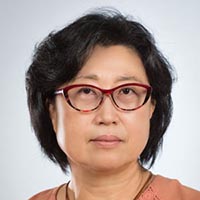
Does God exist? Do we survive our bodily death? Does life have a meaning? What is the best life a person can lead? Is beauty in the eye of the beholder? Professor and department-chair Hye-Kyung Kim, is available to ponder your philosophical questions both great and small.