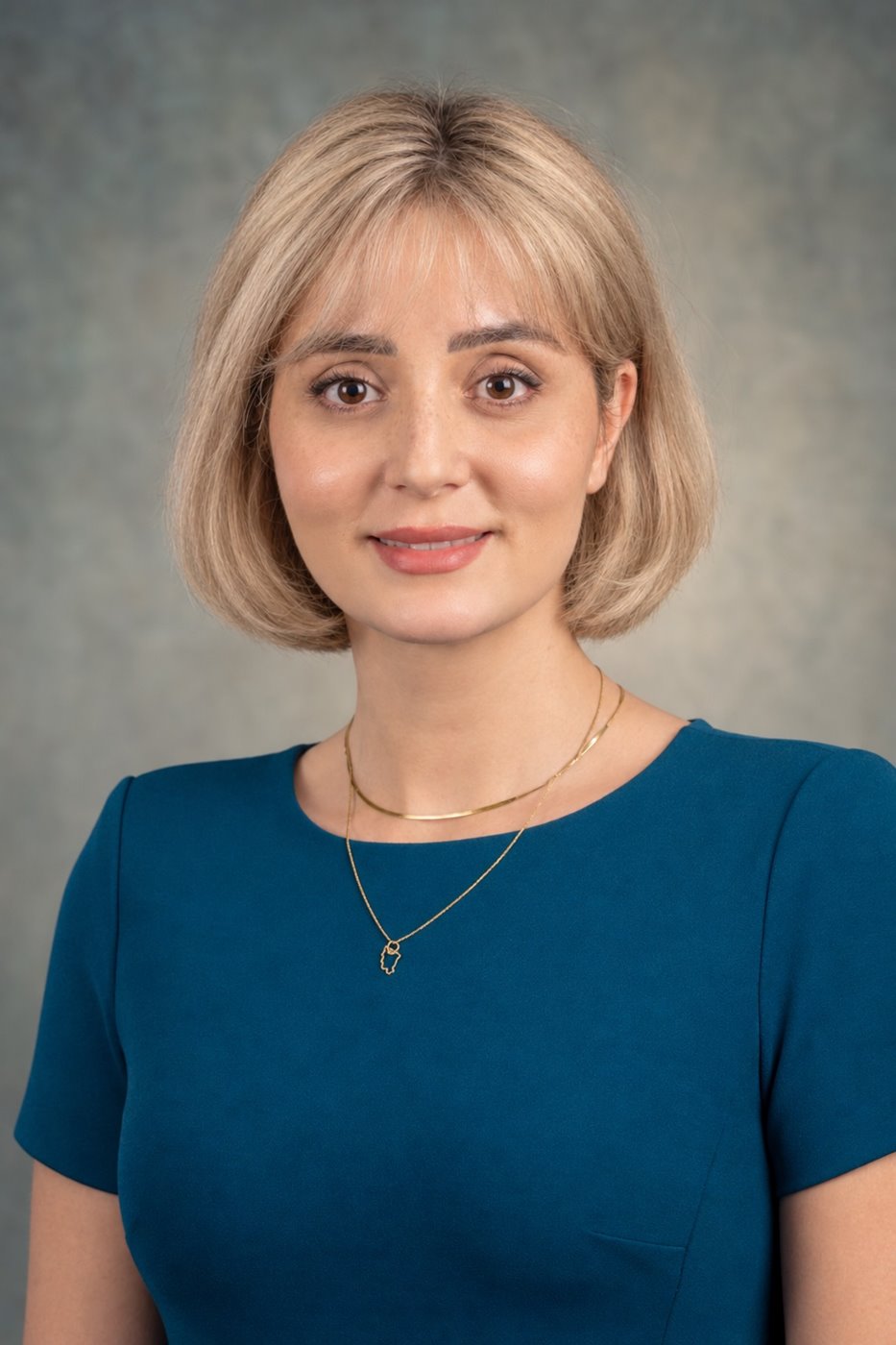
Bahare Askarian
Professor Bahare Askarian is an Assistant Teaching Professor in Business Administration at the Austin E. Cofrin School of Business at the University of Wisconsin–Green Bay. Her work spans supply chain management, business analytics, artificial intelligence, operations research, and emerging technologies. She is particularly interested in applying optimization, machine learning, predictive analytics, and AI-enabled decision support to real-world challenges in transportation, logistics, healthcare, sustainability, and business operations.
Professor Askarian is a Ph.D. candidate in Industrial and Systems Engineering at the University of Missouri–Columbia. Her doctoral research develops energy-aware and sustainable mathematical optimization models for transportation networks supporting medical and other time-sensitive deliveries. Her work incorporates multimodal transportation, drone technology, routing and scheduling, and equitable access for rural and hard-to-reach communities. She holds an M.S. in Industrial Engineering from Amirkabir University of Technology and a B.S. in Applied Mathematics from Alzahra University. She also holds a MicroMasters in Statistics and Data Science from the Massachusetts Institute of Technology (MIT).
Professor Askarian’s research includes AI-driven predictive analytics, sustainable and healthcare logistics, perishable-goods distribution, and supply chain optimization. Her peer-reviewed work includes an interdisciplinary AI study published in ACS Catalysis and research on mathematical models for transportation and logistics. She has also served as a peer reviewer in the field of operations research. Professor Askarian brings industry experience in business and data analytics, including forecasting, pricing, cost analysis, performance evaluation, and data-informed decision support. Her technical expertise includes Python, SQL, Gurobi, mathematical modeling, simulation, statistical analysis, and machine learning.
Professor Askarian teaches undergraduate and graduate courses in supply chain management, project management, sustainability, and business analytics. She has also supported courses in production and operations analysis, quality engineering and analytics, and supply chain modeling and analysis. Her teaching combines analytical foundations with real-world business examples, experiential learning, AI tools, and emerging technologies. She is committed to creating an inclusive learning environment and preparing students to make thoughtful, data-informed decisions in rapidly evolving professional settings.